








The Last Round: Is Consolidation the Spirits Industry's Final Play?
As wine and spirits sales slide, the industry is betting big on mergers. But is joining forces a genuine path forward — or simply a more comfortable way to decline?
We have entered an era of deep uncertainty — economic, geopolitical, and cultural — and the wine and spirits industry finds itself caught squarely in its crossfire. Consumer preferences, particularly among younger demographics, have been shifting away from alcohol for years. Latest research from IWSR showcases that despite an increase in LDA consumers, their drinking habits are a consequence of deliberation and intention, rather than experimentation. Overall participation has edged up to 74% in 2025, compared to 72% in 2023, narrowing the gap with the total adult population from nine percentage points to just three, this growing engagement is paired with a marked decline in consumption breadth: the average number of alcohol categories consumed per occasion has dropped sharply from 2.8 to 1.8 over the past two years.
A similar pattern is emerging among Millennials, particularly in the United States, where moderation trends are strengthening. The average number of categories consumed by Millennials declined from 6.3 to 5.9 year-on-year, while the number of categories consumed per drinking occasion fell from 2.1 to 1.7. At the same time, on-trade consumption is also slipping, with the share of Millennials visiting bars or restaurants dropping from 41% to 36% over the same period.
If demographic shifts were not pressure enough, a wave of tariffs has compounded the damage, primarily triggered by US trade policies; and lingering fractures in global supply chains, and you have an industry facing pressure from virtually every direction at once. The 15% tariffs dictated on European wines seems have had an adverse effect on not just European producers but also American wine producers, resulting in lesser American wine exports and increased prices on European imports in the USA by 15-30%. A 50% tariff levied on Indian exports to the States has also caused an imbalance in sales for Indian origin spirits. USA’s neighbour Canada seems to have halted US imported goods from moving into the country, in response to the 35% tariffs levied on Canadian goods.
Despite wine and spirits holding a centuries-old place in human culture — as facilitators of community, celebration, and connection — that cultural currency is no longer the commercial guarantee it once was. Production has been capped, portfolios trimmed, marketing budgets redirected. And yet, the needle has barely moved.
The pie which has been the same size for ages now has to cater to a number of people trying to claim a slice of it. And the number of people claiming their share has only multiplied dramatically. What was once a relatively concentrated market of major players and loyal consumers now looks more like a crowded room. It’s time to be brutally honest: the air is running thin and pie is running out.
The Fork in the Road
Faced with this reality, producers have two broad choices. They can continue competing for an increasingly thin sliver of a stagnant market — a strategy that, for many, ends in irrelevance or insolvency. Or they can consolidate: pooling resources, brand equity, distribution networks, and geographic reach to create something that can weather the storm more sustainably.
In recent years, the industry has increasingly chosen the latter. Consolidation has been rippling through virtually every layer of the beverage supply chain — from producers and distillers to distributors and retail chains. Big names like Southern Glazers Wine and Spirits acquired other key players like Eagle Rock Distributing Co. and Clare Rose Inc.; and E. & J. Gallo Winery acquired Four Roses Distillery and Rombauer Vineyards among 14 other acquisitions. Looking at this pattern the logic is straightforward: in a contracting market, scale becomes a form of survival.
But let’s also address the end result of what this move could mean for the industry: does consolidation actually grow the pie? Or does it simply ensure that fewer, larger players are left to fight over what remains of it?
The Merger That Could Reshape the Shelf
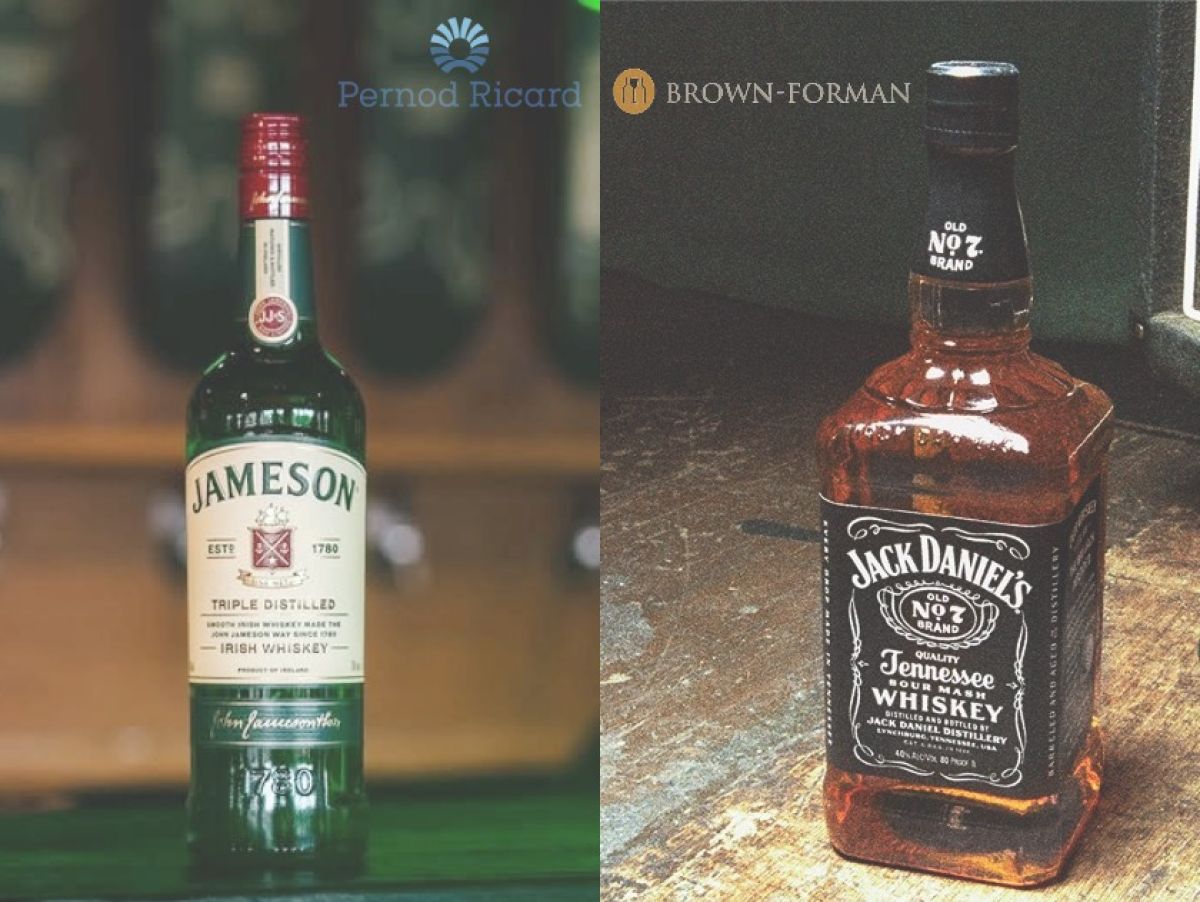
No proposed deal makes that question more urgent than the recently confirmed discussions between Pernod Ricard and Brown-Forman — two of the most recognisable names in global spirits.
Pernod Ricard, with consolidated sales of approximately €10.9 billion in FY25, needs little introduction. Its portfolio spans Absolut vodka, Jameson Irish whiskey, Chivas Regal and Ballantine’s Scotch, Martell cognac, Beefeater gin, and Mumm and Perrier-Jouët champagnes — a roster that covers nearly every premium category on the global shelf.
Brown-Forman, headquartered in Louisville, Kentucky, brings a different but equally compelling set of assets to the table. Its portfolio — built over 155 years on the founding promise of “Nothing Better in the Market” — includes Jack Daniel’s, Woodford Reserve, Old Forester, Herradura and el Jimador tequilas, Diplomatico Rum, Gin Mare, Fords Gin, and a growing collection of Scotch whisky distilleries in GlenDronach, Glenglassaugh, and BenRiach.
Together, the combined entity would command an extraordinary breadth of category coverage — whiskey, gin, cognac, rum, tequila, vodka, champagne — with a geographic footprint that spans more than 170 countries. In a statement confirming the discussions, Pernod Ricard described the contemplated combination as “a merger of equals” that would create a global spirits leader with enhanced scale, a powerful brand portfolio, and significant operational synergies.
On paper, it is a compelling proposition. Pernod Ricard’s distribution infrastructure and exposure to high-growth emerging markets, paired with Brown-Forman’s iconic American whiskey brands and loyal consumer base, would produce a portfolio with very few obvious gaps. The synergies in procurement, logistics, market access, and overhead would be significant.
A Merger of Equals, Or of Necessity?
The phrase “merger of equals” is one that corporate communications teams reach for when they want to soften what is, in reality, a complex negotiation between two parties of unequal size and leverage. With Pernod Ricard’s revenues considerably outpacing Brown-Forman’s, the power dynamics of any eventual agreement will be worth watching closely.
More importantly, the deal raises a broader question about what consolidation actually achieves in a declining market. History offers mixed evidence. Large mergers in consumer goods can unlock genuine efficiencies and extend the runway for struggling businesses. But they can also create bloated, slow-moving organisations that struggle to respond to precisely the kind of cultural and demographic shifts that are driving the downturn in the first place.
The spirits industry’s younger consumer problem is not a distribution problem, or a portfolio gap problem, or a scale problem. It is a problem of relevance. And relevance is not something that can be acquired in a merger.
Consolidation as the New Normal
Pernod Ricard has confirmed that discussions regarding a potential business combination with Brown-Forman are ongoing and that no agreement has been reached as of yet. In the current environment, a deal of this nature makes considerable strategic sense for both parties. It reduces duplication, strengthens negotiating power with distributors and retailers, and creates a platform capable of sustaining long-term investment in brand building.
But it would be a mistake to read consolidation as a solution to the industry’s underlying challenges. At its most pragmatic, it is a strategy for managing decline more gracefully — ensuring that the players who remain are financially robust enough to ride out a prolonged period of contraction and, perhaps, position themselves for recovery when consumer sentiment eventually shifts.
The beverage industry has been here before. Categories have fallen in and out of favour. Wine displaced beer. Whiskey displaced wine. Craft spirits disrupted legacy players. The cycle is not new. What is new is the speed and scale of the current shift and the degree to which demographic change, rather than cyclical preference, may be driving it.
For now, consolidation is the move the industry knows how to make. Whether it is the right move, or merely the easiest one, remains to be seen. What is certain is that a combined Pernod Ricard and Brown-Forman would enter a difficult market as one of its most formidable contenders. The harder question however is whether formidable is enough.
Header image sourced from Absolut Vodka and Jack Daniel US.